Dispatch
The Black Swan
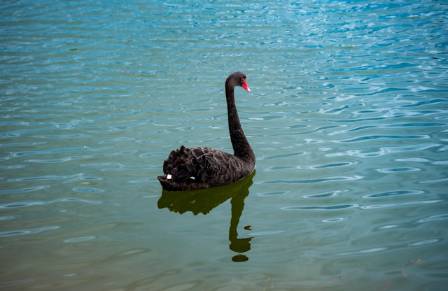
The Black Swan (Cygnus atratus) is a remarkable waterbird that originated in Australia. Its dark plumage and vivid red bill give it an unmistakable appearance. This large swan is especially widespread in the southeastern and southwestern parts of Australia. Rather than following a fixed migration route, Black Swans are largely nomadic and move from place to place in response to changing weather and water conditions.
Mira Blake
Rider
Desk note
Full dispatch and transfer tips sit below.
Line
Blue Line Walk
The Black Swan (Cygnus atratus) is a remarkable waterbird that originated in Australia. Its dark plumage and vivid red bill give it an unmistakable appearance. This large swan is especially widespread in the southeastern and southwestern parts of Australia. Rather than following a fixed migration route, Black Swans are largely nomadic and move from place to place in response to changing weather and water conditions.
During the breeding season, both parents share responsibility for incubating the eggs and caring for their offspring. Black Swans were introduced to several countries during the 19th century as ornamental birds, and populations have since become established and stable in a number of regions around the world. The species has become an important regional symbol of Western Australia and the English town of Dawlish, and it is also commonly displayed in zoos and private bird collections.
Description
Physical Appearance
Black Swans are large and impressive birds, measuring approximately 110–142 centimetres in length. Their wings can span between 1.6 and 2 metres, while their weight ranges from about 3.7 to 9 kilograms.
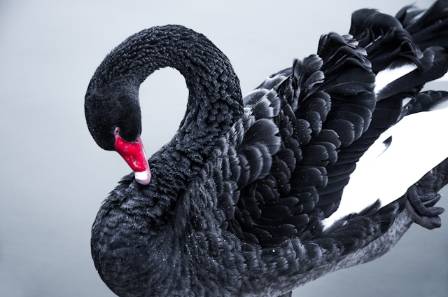
Most of the body is covered in black feathers, which contrast with the white flight feathers visible when the wings are spread. The bill is bright red and features a pale band and lighter tip. Their legs and feet are generally greyish-black.
Males tend to be somewhat larger than females and usually have longer, straighter bills. Newly hatched cygnets look very different from adults, with grey-brown plumage edged in pale colouring.
Vocalisations
The Black Swan produces a range of sounds, including musical calls resembling a bugle as well as softer, crooning vocalisations. When alarmed or disturbed, it may produce a whistle, particularly around the breeding and nesting period.
An agitated bird may also raise its feathers or wings while swimming, creating an intimidating display toward a perceived threat.
Habitat
Black Swans are native to southwestern and eastern Australia. Populations have also been introduced and established in places including New Zealand, the United Kingdom, Japan, the United States, and China.
Preferred Environments
These adaptable swans can occupy freshwater, brackish, and saltwater habitats. They are commonly found on lakes, rivers, and wetlands, as well as flooded grasslands and tidal mudflats. On occasion, they may also occur close to the open ocean.
Details
Across Australia, Black Swans are particularly associated with wetlands and coastal islands. Their numbers are highest in the southwestern and southeastern parts of the country, while they are less common through central and northern Australia.
They can make use of many different types of wetlands as long as suitable vegetation and water are available. Their nomadic lifestyle is strongly influenced by rainfall. When rain creates suitable water sources in otherwise dry regions, Black Swans may move into those areas.
If drought develops before their cygnets have become independent, breeding birds may abandon their nests and move back toward wetter habitats. During their annual moult, they generally remain on large bodies of water where they are safer while temporarily unable to fly.
The species has an extensive distribution and maintains a relatively stable population, with the total number of Black Swans estimated to reach as many as 500,000 individuals.
Diet
Primary Diet
Black Swans are primarily plant eaters. Their food consists largely of aquatic vegetation and plants growing in wetland environments.
Key Foods
Important food sources include reedmace (Typha), algae, Vallisneria, Potamogeton, and stoneworts.
Foraging Behaviour
Aquatic and marsh vegetation forms the foundation of the Black Swan's diet. In New South Wales, the birds commonly consume reedmace leaves, underwater algae, and Vallisneria. In Queensland, they often feed on Potamogeton, stoneworts, and algae.
When water levels rise and inundate surrounding vegetation, the swans may also take advantage of plants growing along the edges of wetlands.
Their feeding technique is particularly graceful. They may lower their heads and long necks beneath the water to collect vegetation or tip their bodies forward to reach food in deeper water. They can also feed at the surface by filtering and gathering floating plant material.
Behaviour
Nesting
Black Swans generally form long-lasting monogamous partnerships, with pairs commonly remaining together throughout their lives. Divorce is relatively uncommon, estimated at only around 6 percent.
Their nests are substantial structures made from reeds, grasses, weeds, and other plant materials. They are usually constructed in shallow water or on islands.
A typical clutch contains four to eight greenish-white eggs. Both parents participate in incubation, which lasts approximately 35–40 days.
After hatching, young cygnets remain dependent on their parents for roughly nine months. During longer journeys, the young may climb onto their parents' backs and be carried through the water.
Mating Rituals
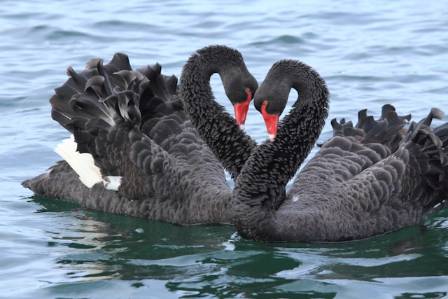
Courtship between Black Swans can resemble a coordinated aquatic performance. The pair stretches its necks, lowers them into the water, and performs synchronized movements that may continue for as long as 20 minutes.
The actual mating process is considerably less graceful. The male climbs onto the female's back, and after a brief period in which both birds may disappear partially beneath the water, they surface again. The male then slips back into the water.
Territoriality
Black Swans can become highly defensive when protecting their nesting areas. They may use both their powerful wings and bills to drive away intruders.
Flocking Tendencies
Outside the breeding period, these birds often gather in loose social groups. Such gatherings can contain several hundred individuals and, in suitable locations, may grow to many thousands.
Conservation Status
The Black Swan currently has a strong overall conservation outlook. Its worldwide population is estimated to reach up to approximately 500,000 birds, and there has been no major overall decrease in population numbers.
Threats
The species is not currently regarded as threatened. The IUCN Red List classifies the Black Swan as Least Concern, indicating that it does not presently face significant population-level threats.
Protection
Black Swans receive full legal protection throughout Australia's states and territories. The National Parks and Wildlife Act 1974 provides protection against hunting and other forms of harm.
Fun Facts
The Black Swan has the longest neck in proportion to body size among the world's swans. One of the most charming sights is a parent carrying its young on its back while swimming.
Very occasionally, individuals with leucism are observed. These unusual birds have predominantly white plumage rather than the typical black appearance.
The Black Swan also holds cultural significance in Western Australia, where it appears on the state's coat of arms as well as on postage stamps.
5 Surprising Facts about the Black Swan
Not Completely Black
Despite its name, the Black Swan is not entirely black. When it opens its wings, the large white flight feathers become clearly visible, creating a striking contrast with the dark body.
Australian Native
Black Swans may now be found in several countries outside Australia, but their natural origin is Australia.
They Need a Long Takeoff Run
A Black Swan requires approximately 40 metres of unobstructed water to build enough speed for takeoff.
Moulting Mishaps
After the breeding season, Black Swans shed their flight feathers during moulting. Because of this temporary loss, they are unable to fly for roughly one month.
They Are Not Always Sexually Faithful
Black Swans establish strong pair bonds, but forming a long-term partnership does not necessarily mean that every mating is exclusively between the same two individuals.
Similar Species
Magpie Goose
From a distance, a Black Swan can occasionally be mistaken for a Magpie Goose. However, the Black Swan has a considerably longer and more curved neck. Its wingbeats are also slower, whereas the Magpie Goose tends to beat its wings more rapidly.
Mute Swan
The Mute Swan shares some general characteristics with the Black Swan, but the two species are easy to distinguish when seen clearly. Mute Swans are larger and have completely white plumage accompanied by bright orange bills.
Black Swans, on the other hand, are covered primarily in dark feathers and have vivid red bills, making their overall appearance unmistakable.
Nearby stops
 STOP
· en
Albatrosses: Inspiring Legends & Myths
Lucian West
 STOP
· en
Discover the Magic of Atolls and How These Natural Coral Rings Form in Our Oceans
Eva Harrison
 STOP
· en
Are Modern Off-Road Trucks Too Capable to Be Fun?
Sophia
 STOP
· en
8 Simple Strategies for Fostering Family Happiness
Grace Aurora
 STOP
· en
Impressions of Chinese Gardens
Elian Prescott
 STOP
· en
Understanding Nighttime Hunger and Sleep Quality
Louis Wood